
Comparison · Choosing a process
Most teams pick a cutting process out of habit — the machine they own, the method they know best. That works until the part changes: a new material, a thinner section, a tolerance that can't move, an edge that can't be reworked, a heat-affected zone that can't be allowed. At that point the better question isn't "which process is best?" — there's no universal best — but "which process fits this part?"
This guide gives you a way to answer that. First, the criteria that actually decide. Then a clear-eyed profile of the main processes against those criteria. Then a simple framework for choosing — and an honest note on where the processes are complementary rather than competing.
Start with the criteria, not the machine
Before comparing machines, get specific about what the part demands. Eight criteria carry most decisions:
- Material integrity — can the part tolerate heat (a heat-affected zone, recast layer, micro-cracks) or mechanical stress, or must its properties be preserved for function, fatigue or certification?
- Material range — one well-behaved material, or many — including hard, brittle, reflective, precious or experimental ones?
- Edge quality — is a finished, burr-free edge required straight off the machine, or is a secondary finishing operation acceptable?
- Geometry — flat or bevelled 2D profiles, or true 3D features, threads and pockets?
- Tolerance and repeatability — what precision do you need, and how consistently across a run?
- Tooling and lead time — is custom tooling viable, or do you need to go from CAD to part fast (prototypes, low volume, frequent changes)?
- Speed and volume — high-rate production of simple shapes, or high-mix/low-volume work?
- Total finished cost — including tooling, finishing, inspection and scrap — not just the cost of the cut itself.
Score your part against these and the right process usually selects itself.
How the main processes measure up
Laser cutting — thermal. Fast and economical on thin flat sheet in common metals, with no tooling and excellent nesting. But it adds a heat-affected zone, struggles with reflective, thick, heat-sensitive and brittle materials, and leaves an edge that may need finishing. (Detail: waterjet vs laser.)
Wire EDM — precise on electrically conductive metals, excellent for fine detail and hardened steels. But it's a thermal process (recast layer), it only works on conductive materials, and it can be slow. (Detail: micro waterjet vs EDM.)
CNC machining — unmatched for true 3D geometry, threads, pockets and fine finishes, and economical at volume on machinable metals. But it needs tooling and lead time, contact forces stress thin parts, and hard or brittle materials drive wear and chipping. (Detail: waterjet vs CNC.)
Conventional ("macro") waterjet — non-thermal and material-agnostic, but engineered for thick plate and throughput, not micron precision on small parts.
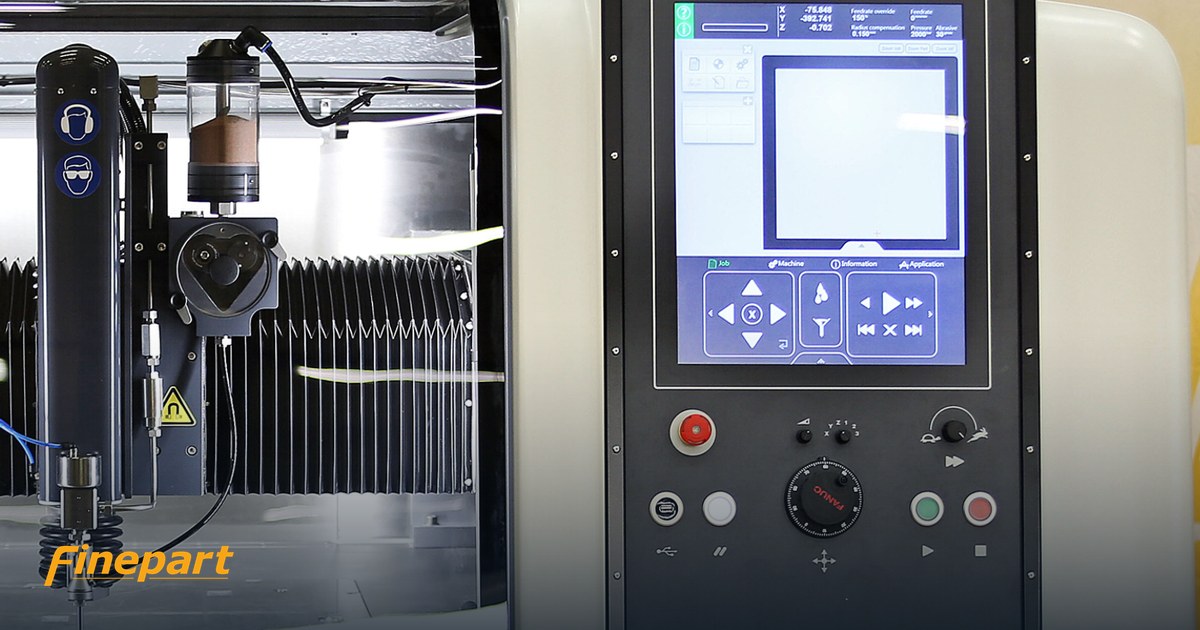
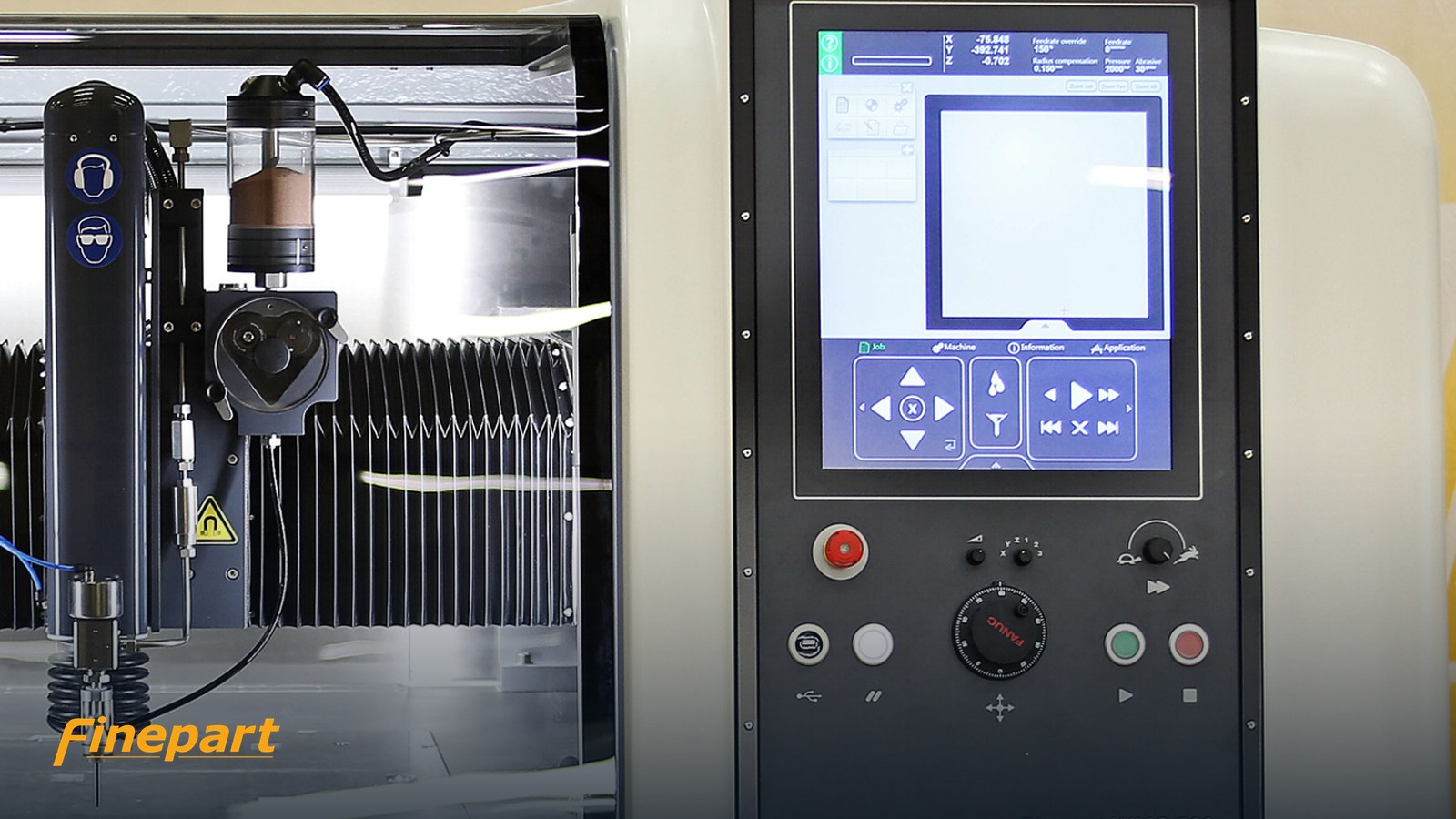
Micro abrasive waterjet — non-thermal, no tool contact, micron precision (≈±1.5 µm positioning, ±0.01 mm tolerance, ~0.2 mm jet), virtually any material on one platform, burr-free edge, no hard tooling. Built for small, complex, material-sensitive parts — at the cost of abrasive consumption and raw plate-cutting speed.
A simple way to decide
- Need true 3D features on machinable material → CNC (often with waterjet-cut blanks).
- Thin flat sheet, high volume, heat acceptable → laser.
- Conductive metal, very fine detail, heat acceptable → wire EDM.
- Thick plate, precision not critical → conventional waterjet.
- Heat-sensitive, reflective, brittle, thin, fatigue-critical or hard-to-machine — or a new material, or no tooling viable → micro abrasive waterjet.
The honest summary
These processes are complementary far more often than they're rivals; the best shops use the right one per feature and frequently combine them — waterjet to profile a difficult-material blank without heat or stress, CNC to finish the 3D detail. Micro abrasive waterjet's sweet spot is precise: small, complex, high-value or material-sensitive parts where edge quality and material integrity are worth more than raw cutting speed — and where the ability to cut any material on one platform turns material innovation into manufacturable parts.
Want a second opinion on a specific part? Send the drawing and the material and we'll tell you honestly which process fits — and cut you a sample. Or explore the Finecut range.
Frequently asked questions
What's the most important factor when choosing a cutting process?
Usually material integrity — whether the part can tolerate heat or mechanical stress — followed by material range and the required edge quality. Those three eliminate most options quickly.
Is there one process that does everything?
No. But for small, complex, material-sensitive parts across the widest range of materials, micro abrasive waterjet covers the most ground without heat or tooling.
How do laser, EDM, CNC and waterjet differ at a glance?
Laser and EDM are thermal (they add heat); CNC is mechanical contact (it can stress parts and wear tools); micro abrasive waterjet is cold and contact-free. That's the fault line that decides most material-sensitive parts.
Can I combine processes?
Yes, and often you should — for example, waterjet to profile a difficult-material blank without stress, then CNC to add 3D features and finishes.