
A straight inlet stabilises the incoming flow.
The cutting principle
Cold force.
Fine control.
A high-velocity stream of water, garnet and air removes material by controlled erosion—without heat, electrical conductivity or mechanical tool contact.
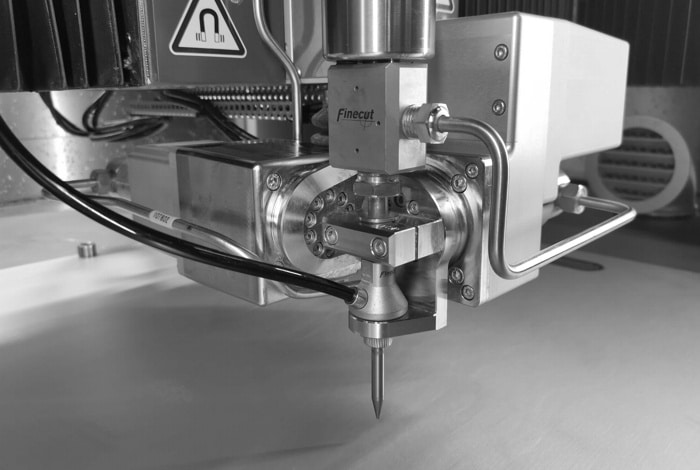 Finecut process zone
ProcessNon-thermal
Fine kerf≈ 0.2 mm
MaterialsVirtually any
Typical part tolerance (3-axis cutting)±10 µm
Inside the cutting head
Pressure becomes
particle velocity.
The waterjet formed at the orifice breaks into high-speed droplets. In the mixing chamber, the droplets transfer energy to fine abrasive particles. The focusing tube aligns the mixture into a narrow particle stream that erodes the workpiece.
A fine waterjet forms and accelerates.
Droplets transfer energy to the abrasive.
Water, air and abrasive particles are accelerated and aligned in the focusing tube to form a fine, coherent, high-velocity stream.
Material is removed by fine particle impacts—without a heat-affected zone.
A particle stream—not a water core
Approximately
4 · 1 · 95
Why the particle stream matters
The abrasive particles remove material through many small impacts. Low cutting forces help protect delicate features and simplify fixturing, while the non-thermal process preserves material properties without a heat-affected zone. The volume proportions describe the stream; they do not indicate the share of cutting force or energy.
Control the outcome
Cut quality is
a production choice.
Cutting speed, jet alignment, process parameters and motion accuracy determine the result together. Higher feed rates favour fast separation; lower feed rates allow a finer surface finish. Finepart extends the commonly used Q1–Q5 scale to Q9 for its finest, taper-free micro abrasive waterjet result.
Fast separationQ1Q2Q3Q4Q5Q6Q7Q8Q9Taper-free precision
Higher feed rate · faster separationLower feed rate · finer surface finish
Balance cutting speed and surface finish
Rough cutting can be around 10 times faster than cutting for the best possible surface finish. The actual ratio depends on the material, thickness, geometry and process settings. Select the quality level from the part requirements, then verify the cutting time and finish with a test cut.
How accuracy is achieved
Four systems.
One result.
Machine geometry
Rigid construction, high-quality motion components and meticulous build establish the mechanical foundation.
Workpiece stability
Flatness, fixturing, temperature and residual stress must be controlled around the part.
Jet behaviour
Nozzle alignment, pressure, abrasive flow, speed and stand-off determine process efficiency.
Control & calibration
Servo optimisation and laser calibration turn geometry into repeatable motion.
Go deeper
Process knowledge.
Production evidence.
Explore the engineering, material behaviour and production economics behind Finecut—or validate your own application at the Finepart Centre of Excellence.
A lower-risk route to production
Validate your application.
Then choose your system.
Start with a test cut in your material. Measured results provide the basis for selecting the right Finecut configuration.
- 01Task
Share the drawing, material, functional requirements and tolerances.
- 02Analysis
We assess process fit, capability, cutting time and system concept.
- 03Verification
Your critical features are test cut in representative material.
- 04Solution
Finepart presents the recommended production solution and offer.
- 05Quickstart
Pre-series cutting and training can begin while the system is built.
Make the principle measurable
Your material.
Our test cut.
Send Finepart a drawing and a material sample. We will focus the evaluation on the geometry and functional requirements that matter to your product.
Request a test cut ↗Finepart archive
Explore the complete archive.
Original articles, technical comparisons and cutting examples, with their publication dates.
Browse all articles ↗