
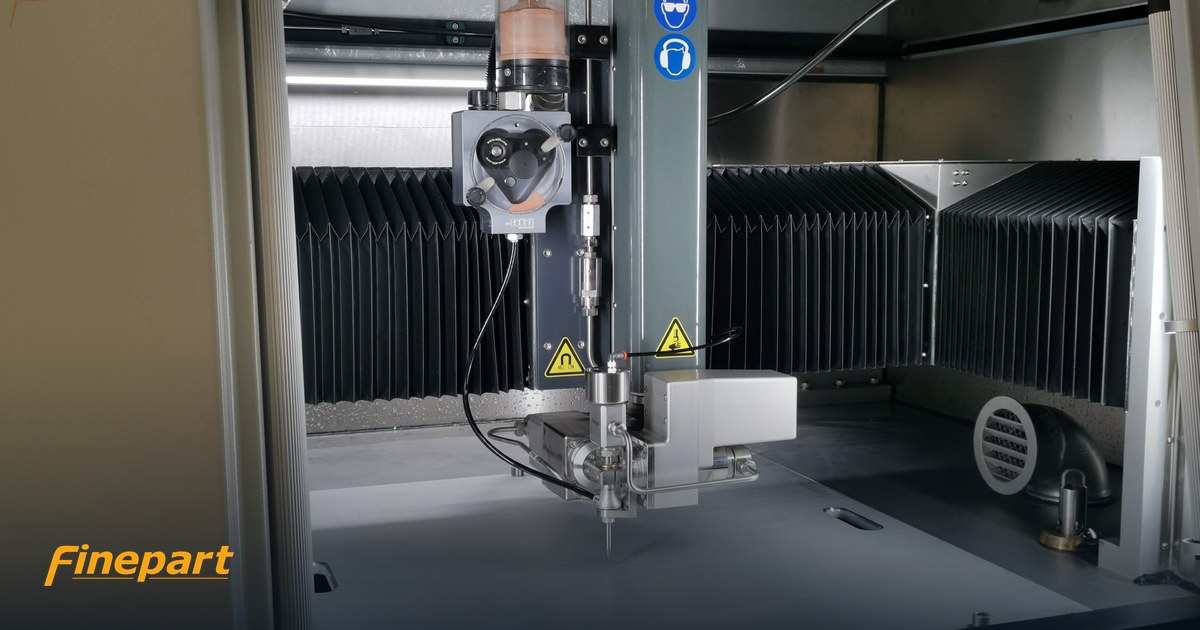
Comparison · Waterjet vs CNC machining
Waterjet vs CNC machining: cutting complex precision parts without custom tooling
CNC machining is the default for precision parts, and for a huge range of work it’s the right choice. But two of its costs never appear on the drawing — everything that has to happen before the first chip is cut, and the physical contact that wears the tool and stresses the workpiece. On small, complex, material-sensitive components they often decide more than the cut itself.
The core difference
How each process removes material
CNC — subtractive by contact
A tool touches the part
A rotating cutter (milling), a rotating part against a tool (turning) or an abrasive wheel (grinding) physically removes material, guided along multiple axes by a program. The tool touches the part, and force flows through both.
Waterjet — erosion
Nothing touches, nothing heats
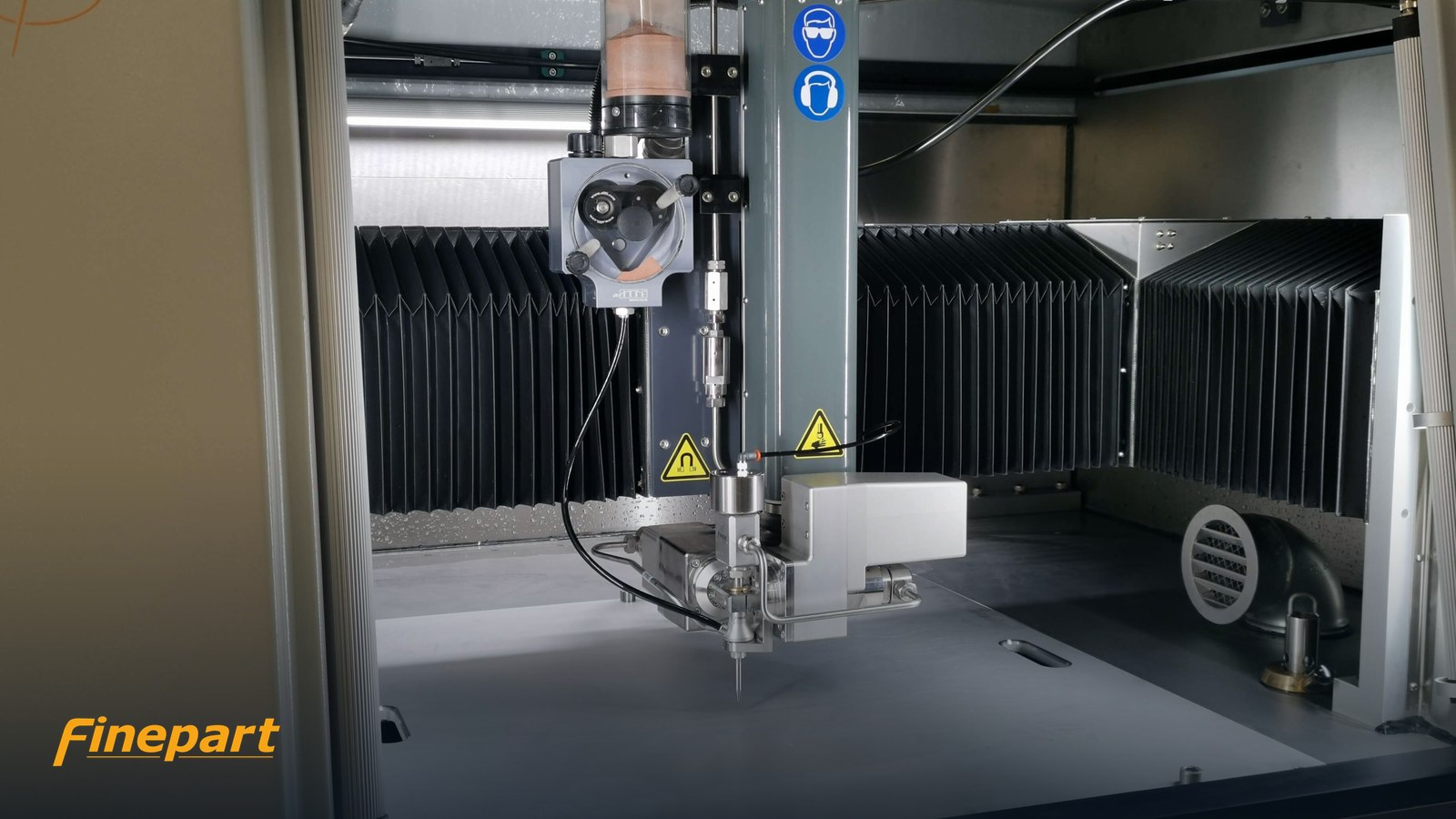
A fine, ultra-high-pressure jet of water — around 4,000 bar — carries hard abrasive particles that erode the contour particle by particle. Nothing touches the part except the jet, and nothing heats it.
That single distinction is the root of every difference below.
Economics
Tooling and lead time
A CNC job has to be engineered before it runs. You select tools, design and build fixtures, write and prove out the program, and cut a first article. That set-up is fixed cost and lead time — frequently days to weeks — and it only makes economic sense when amortised across a production run. For prototypes, one-offs and high-mix/low-volume work, that overhead dominates.
Micro abrasive waterjet cuts complex 2D and bevelled profiles straight from CAD, with flexible fixturing and no hard tooling. There’s nothing to commission between design and part, so a one-off costs roughly what a part in a small batch does, and a design change becomes a re-cut rather than a re-tool. Teams routinely go from CAD to a physical part the same day — which is why it’s so often the first technology an R&D group reaches for.
Force
Mechanical stress and thin parts
To machine a part you must clamp it and push a tool through it. Those forces distort thin, springy or delicate components and can leave residual stress that shows up later as warping or reduced fatigue life. Thin walls deflect away from the cutter; spring elements lose their set; delicate features chatter.
Because waterjet applies negligible contact force, parts come off the machine unstressed, with their properties intact. That matters acutely for thin sections, for components whose spring behaviour must be preserved (such as nitinol), and for any part where induced stress would compromise function or certification.
Capability
Materials and geometry
Hard and brittle materials punish mechanical tooling. Engineering ceramics, sapphire and hardened alloys accelerate tool wear and chip under point loads — and some of that damage is sub-surface, invisible to inspection but a weak point in service. Intricate internal features and small radii are also slow or impractical to reach with a rotating tool.
Micro abrasive waterjet cuts virtually any material on one platform — metals, ceramics, sapphire, composites, even experimental materials — and pierces its own start holes, so complex internal contours and radii down to around 0.1 mm can be cut in a single set-up. A Swedish aerospace manufacturer, Brogren Industries, adopted it precisely because it could cut the nickel superalloy Haynes 282 with zero thermal impact and no mechanical stress — a material that punishes thermal and contact-based methods alike. The same advantage applies to advanced ceramics and sapphire, where mechanical tools chip and crack.
Precision
Tolerance and finish
Micro waterjet positioning accuracy
With part tolerances near ±0.01 mm and a burr-free, taper-controlled edge that often needs no secondary finishing.
CNC, for its part, holds excellent tolerances on 3D features and can achieve surface finishes waterjet can’t. They’re strong at different things — which is the point.
The honest part
Where CNC still wins — and what the finished part costs
CNC’s domain
True 3D, threads, finishes
This is not “waterjet beats CNC.” True 3D sculpting, threads, blind pockets and fine surface finishes are CNC’s domain, and on routine machinable materials it’s fast and economical. In practice the two are complementary far more often than they’re rivals: profile difficult-material blanks on waterjet without heat or stress, add the 3D detail on CNC.
Total cost
Judge the finished part, not the cut
The cut that looks cheapest rarely makes the cheapest finished part. Count the tooling, the finishing operations, the inspection and the scrap. For low-volume, high-mix and difficult-material work, waterjet’s no-tooling, no-finishing, low-scrap profile frequently wins on total cost — while high-volume runs of simple machinable parts favour CNC.
See it on your own part
Not sure where your part lands?
Send us the drawing and the material and we’ll tell you honestly — and cut you a sample. Or explore the Finecut range.
No theoretical projections. Just data on your part.
FAQ
Frequently asked questions
Is waterjet more accurate than CNC?
For complex 2D and bevelled profiles in difficult materials, micro abrasive waterjet holds micron tolerances (≈±1.5 µm positioning, ±0.01 mm part tolerance) with no tooling or stress. CNC remains the choice for true 3D geometry and certain finishes.
Does waterjet need tooling like CNC?
No hard tooling — it cuts from CAD with flexible fixturing, which is why it suits prototypes and low volume so well, and why a design change is a re-cut rather than a re-tool.
Can waterjet cut materials CNC struggles with?
Yes — ceramics, sapphire, hardened alloys and nickel superalloys that cause tool wear, chipping or sub-surface damage on a mill are cut cold by micro abrasive waterjet, with no thermal or mechanical damage.
Should I replace my CNC machines with waterjet?
No — they’re complementary. Use waterjet for stress-free profiling of difficult materials and complex 2D shapes, and CNC for 3D features and finishes. Many shops run both, often on the same part.
