
Industry 01
Medical devicesProtect the material. Prove the geometry.
Cut intricate components in Nitinol, titanium, cobalt-chrome, ceramics and polymers without a heat-affected zone or tool-induced stress.
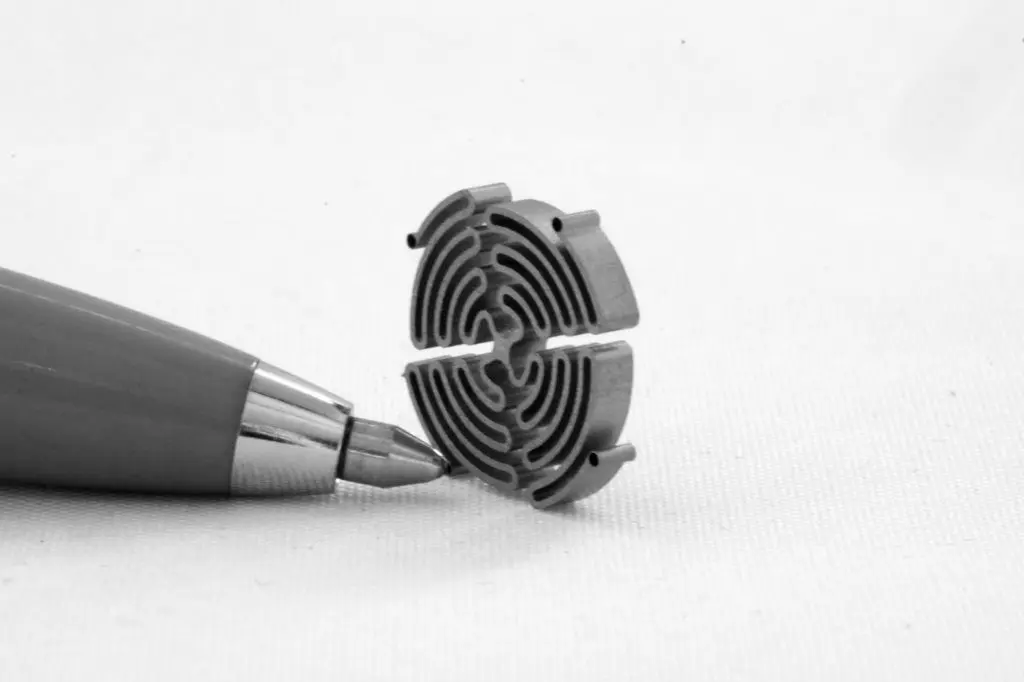
Why Finecut
When the process must protect the part.
Medical parts combine difficult materials, minute features and an uncompromising need for repeatability. Finecut gives development and production teams a cold, low-force process that can move from one-off prototypes to validated series work.
Material integrity
Avoid thermal phase changes, recast layers and local hardening in materials such as Nitinol and titanium.
Small features
Create narrow slots, radii down to approximately 0.1 mm and closely spaced contours with a fine jet.
Process evidence
Build the process around the actual drawing, material, thickness and quality requirement before investment.
Applications built around the requirement.
Every application is qualified against the actual material, thickness, geometry, tolerance, edge-quality target and production volume.
Implants and instruments
Cut titanium, cobalt-chrome, stainless steel and engineering polymers for intricate components and instrument features.
Nitinol components
Preserve shape-memory behaviour by eliminating thermal cutting while producing clips, frames, stents and spring features.
Diagnostics and fluidics
Machine ceramics, glass, polymers and layered structures where conductivity is unavailable and edge integrity matters.
Material focus · Nitinol
Keep heat away from the function.
Nitinol combines shape-memory behaviour, superelasticity and biocompatibility—but its performance can be compromised by heat. Micro abrasive waterjet removes material through cold erosion, avoiding the heat-affected zone associated with thermal processes.
Read the Nitinol technical guide ↗Why it is difficult
Mechanical machining can cause rapid tool wear, while thermal cutting can alter the edge and create additional finishing work.
Where it is used
Applications include stents, guidewires, orthodontic and endodontic tools, surgical clips, instruments and implant components.
What Finecut changes
The same cold process can pierce and contour thin sheet, wire and tube while protecting the material next to the cut.
*Indicative Finecut capability under suitable application conditions. Geometry, material, thickness, tolerance and surface requirements must be verified on the actual part.
Customer proof · Gösta Ullmark AB · 2020
A titanium bone-grafting system, cut to specification.
Orthopaedic surgeon and researcher Gösta Ullmark developed a surgical method, instruments and implants for complicated hip surgery. At the centre of the system is a titanium Graft cup that holds bone graft in place.
Pure titanium is sourced, punched into discs and formed into bowls.
Finepart cuts the cup edge to the specified geometry.
The edges are polished before the system is prepared for international sale.
Read the full customer case ↗Finepart was selected for precision cutting, the ability to define the manufacturing process and the traceability and quality requirements surrounding surgical implants.
Configure the complete system
Start with the part. Select the motion next.
Intricate flat components and repeatable 2D production.
Tubular parts, indexed features and access around cylindrical components.
Angled contours, bevels and complex access where the part cannot remain flat.
Probing, vision, Finesoft job control and application-specific workholding support repeatable setup.
Proof, not assumptions
Validate before you scale.
Move from material and drawing to a documented cutting route—then validate geometry, edge condition and repeatability on the actual part.
Performance depends on the complete application. Finepart uses test cutting and application engineering to define a credible process window and the right Finecut configuration.
Explore the Nitinol process evidence ↗Your application
Bring the difficult part.
Send a drawing, material specification, thickness, tolerance and production target. Finepart will review the geometry and propose the next technical step.
Request a test cut ↗