
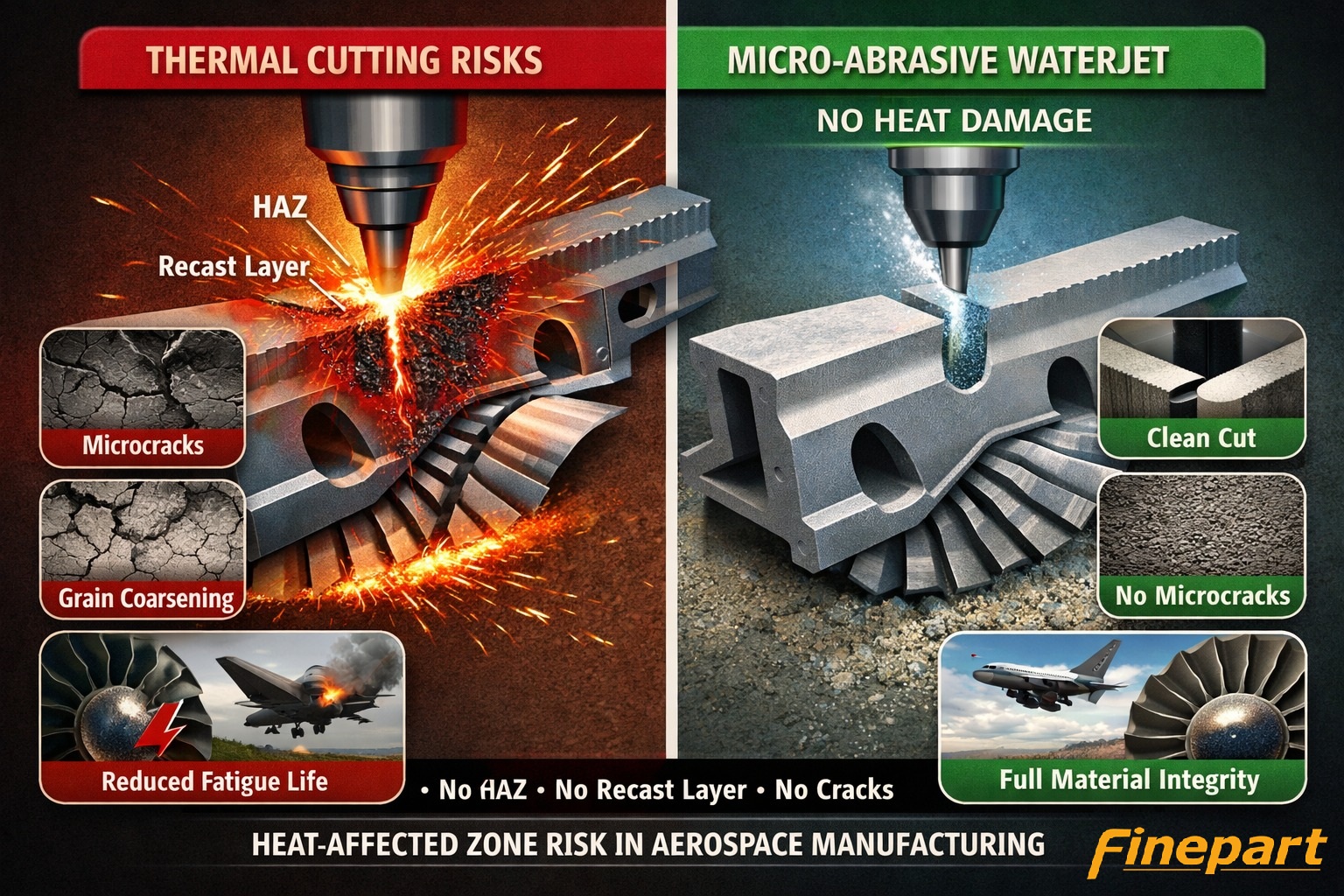
Component failures in aerospace are rarely caused by design. They’re caused by manufacturing processes.
Specifically, they’re caused by what those processes leave behind — invisible changes in material structure that no dimensional inspection will catch. Heat-affected zones, recast layers, residual stress. The kind of damage that passes quality control but compromises airworthiness.
If you’re cutting titanium, nickel superalloys, or advanced ceramics with thermal methods, this concerns you.
What Thermal Cutting Does to Aerospace Alloys
Every thermal cutting process — laser, EDM, plasma — concentrates energy into the workpiece. The material at the cut edge melts or vaporises. But the damage extends further. The surrounding material reaches temperatures high enough to alter its microstructure without melting. This region is the heat-affected zone (HAZ).
In titanium alloys like Ti-6Al-4V, the low thermal conductivity of the material makes this worse. Heat doesn’t dissipate quickly. It lingers, causing grain growth, martensitic phase transformations, and residual stress accumulation deep into the part (Fractory, 2024; BLM Group, 2024).
In nickel-based superalloys such as Inconel 718, the consequences are even more complex. The high temperatures dissolve strengthening precipitates — the gamma-prime (γ’) and gamma-double-prime (γ”) phases that give these alloys their high-temperature performance. What reprecipitates during cooling is often coarser, unevenly distributed, and mechanically inferior to the original microstructure (Zhang et al., 2023).
The result: a component that looks correct but has fundamentally different material properties at every cut edge.
The Recast Layer Problem
Beyond the HAZ, thermal processes create a recast layer — resolidified material at the cut surface with a completely different microstructure from the base material. In laser machining of superalloys, this layer averages around 50 µm thick and contains microcracks that often extend into the parent material (Columbia University — Non-Traditional Manufacturing).
Recent research on high-speed EDM-processed nickel alloys found that the recast layer exhibited a 20.4% increase in hardness but a 16.5% decrease in elastic modulus compared to the base material. Fatigue cracks originated from microcracks, pores, and inclusions within this layer (PMC, 2025).
For aerospace components operating under cyclic loading — which is essentially all of them — this is a critical reliability issue.
How HAZ Reduces Fatigue Life
Fatigue performance is arguably the most important mechanical property for aerospace components. Every flight cycle subjects structural and engine parts to repeated loading. Fatigue cracks initiate at the weakest point in the material — and HAZ regions are systematically weaker than the surrounding base material.
The mechanisms are well documented:
- Loss of precipitate strengthening in the HAZ reduces resistance to crack initiation
- Grain coarsening increases the effective slip length for dislocation movement
- Residual tensile stresses add to service loads, accelerating crack growth
- Microcracks in recast layers provide ready-made initiation sites
Research on laser-drilled Inconel 718 confirms that recast layers and microcracks are considered undesirable side effects with significant influence on mechanical properties in aerospace applications (Petrů et al., 2021).
Studies on very-high-cycle fatigue behaviour of Inconel 718 at 650°C show that fatigue cracks initiate from internal defects — lack-of-fusion zones, inclusions, and microstructural discontinuities — rather than surface features (PMC, 2023). This means that HAZ damage can trigger failure long after the surface has been inspected and approved.
The difference between approved and airworthy often comes down to what happened at the molecular level during cutting.
Micro-Abrasive Waterjet: Cutting Without Compromise
Micro-abrasive waterjet technology removes material through mechanical erosion — a stream of fine abrasive particles carried by high-pressure water. There is no heat source. No thermal energy enters the workpiece.
This means:
- No heat-affected zone. The microstructure at the cut edge is identical to the bulk material.
- No recast layer. Nothing melts, so nothing resolidifies.
- No microcracks. No thermal gradients means no thermally induced cracking.
- No residual thermal stress. The part comes off the machine in the same metallurgical condition it went on.
The Finecut micro-abrasive waterjet achieves ±10 µm cutting tolerance with ±1.5µm positional accuracy and ±1.5µm repeatability. Jet diameters go down to 0.2 mm, enabling precision geometry on small, complex components (Finepart, 2024).
What This Means for Aerospace Materials
Micro-abrasive waterjet handles the full range of aerospace materials without process compromise:
Titanium alloys (Ti-6Al-4V, Ti-6Al-2Sn-4Zr-2Mo): Cut with no thermal input. No alpha-case formation. No embrittlement. Fatigue properties of the base material are fully preserved. Research confirms that abrasive waterjet is effective for cutting titanium alloys where thermal methods create unacceptable HAZ (Štefek et al., 2021).
Nickel-based superalloys (Inconel 718, Waspaloy, Hastelloy): No precipitate dissolution. No TCP phase formation. The γ’/γ” strengthening architecture remains intact through the cut zone.
Engineering ceramics (alumina, silicon carbide, zirconia): Non-thermal cutting avoids thermal shock cracking — a common failure mode when ceramics are processed with laser or EDM.
Composites (CFRP, CMC): No delamination from thermal expansion mismatch. No matrix degradation. No fibre pullout at cut edges. Research on abrasive waterjet machining of CFRP confirms good dimensional accuracy and surface quality (Youssef et al., 2021).
From Prototype to Production — One Process
One often-overlooked advantage: micro-abrasive waterjet scales from proof-of-concept to production qualification without changing the cutting process. The same machine, same parameters, same material response.
This matters for aerospace qualification. When you validate a part cut by micro-abrasive waterjet at the PoC stage, that validation carries through to series production. No requalification needed because the process didn’t change.
Compare this with developing a prototype on waterjet, then switching to laser for production throughput — and discovering that your qualification data no longer applies because the material response is fundamentally different.
The Bottom Line
Thermal cutting methods create invisible damage in aerospace alloys. HAZ, recast layers, and microcracks compromise fatigue life and material integrity in ways that dimensional inspection cannot detect. For safety-critical aerospace components, this is an unacceptable risk.
Micro-abrasive waterjet eliminates that risk entirely. No heat. No microstructural damage. No post-processing to remove recast layers. Parts that are not just dimensionally correct — but metallurgically sound.
Test us with a drawing. Send your most challenging geometry, your most demanding material. We’ll cut a sample at ±10 µm tolerance and let the results speak for themselves.
Sources
- Zhang, J., Lu, F., & Li, L. (2023). “An Overview of Thermal Exposure on Microstructural Degradation and Mechanical Properties in Ni-Based Single Crystal Superalloys.” Materials, 16(5), 1787.
- Petrů, J., Pagáč, M., & Grepl, M. (2021). “Laser Beam Drilling of Inconel 718 and Its Effect on Mechanical Properties.” Materials, 14(11), 3052.
- Štefek, A. et al. (2021). “Impact of Preparation of Titanium Alloys on Their Abrasive Water Jet Machining.” Materials, 14(24), 7768.
- Annoni, M. (2024). “A Review of Waterjet Cutting Research towards microAWJ.” Materials, 17(6), 1268.
- “Recast Layer-Induced Fatigue Degradation in High-Speed EDM Microholes.” PMC, 2025.
- BLM Group (2024). “Heat Affected Zone in Laser Cutting for Aerospace Components.”
- Fractory (2024). “Heat Affected Zone — Causes, Effects and How to Reduce It.”
Contact Us
Interested in micro-abrasive waterjet cutting for your aerospace components? Get in touch with our team.
