
Case Study
Brogren Industries
Company
Brogren Industries, Älvängen
Application
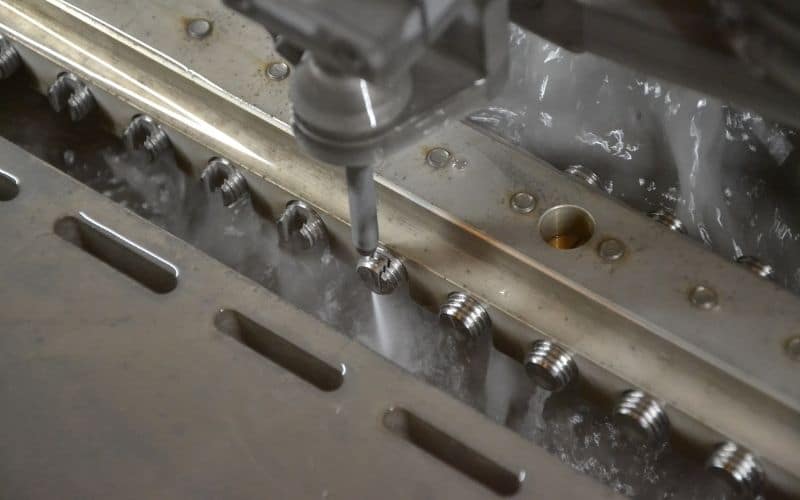
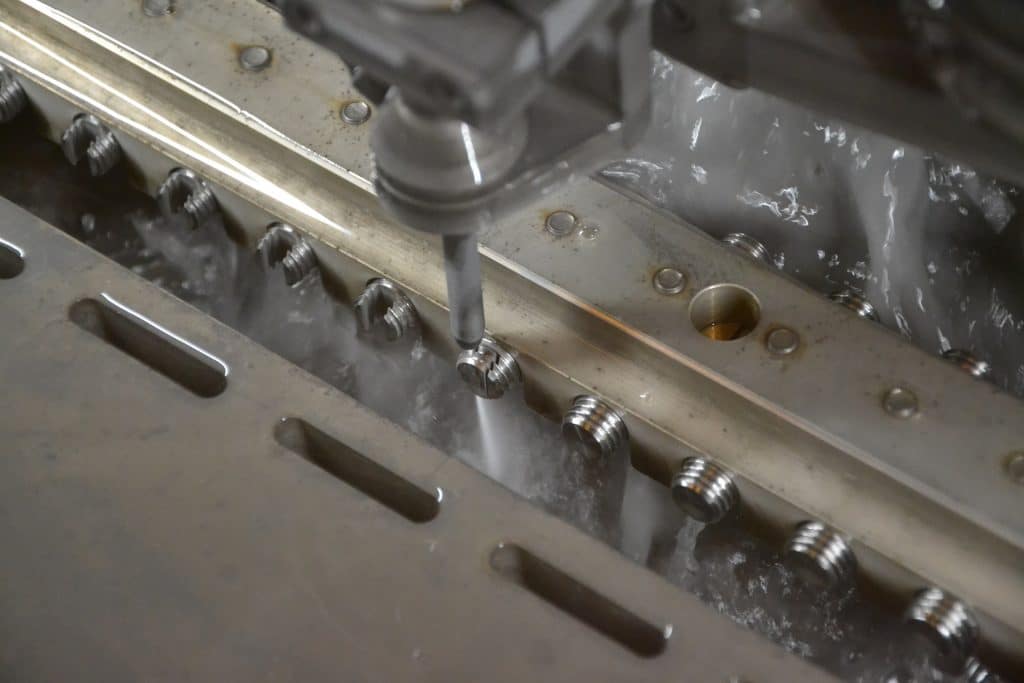
Micro abrasive waterjet, Haynes 282
Year
2020
How Brogren Industries Cut Haynes 282 Without Compromising Material Integrity
Productivity, Quality, and Development
These are the key operational pillars for Brogren Industries. As a Swedish tech company manufacturing advanced components for aerospace and industrial gas turbines, Brogren processes and assembles complex structures using sophisticated welding and machining methods. Operating in a sector where safety and reliability are paramount, their customer relations are built on strict process control and uncompromising quality assurance.
For Brogren Industries, the challenge lies not only in the tight geometric tolerances required by aerospace Tier 1–3 suppliers, but also in the material itself. They work daily with hard-to-machine materials where traditional methods frequently fall short.
The Challenge: Haynes 282 and the Threat of Thermal Damage
In 2018, Brogren Industries encountered a specific manufacturing hurdle: they needed a reliable cutting method for Haynes 282.
Haynes 282 is a high-strength, gamma-prime strengthened nickel-based superalloy originally developed for high-temperature applications. It exhibits exceptional creep strength, thermal stability, and weldability, making it highly desirable for gas turbine components. However, its high strength at elevated temperatures and rapid work-hardening tendencies make it notoriously difficult to machine.
Conventional thermal cutting methods such as laser, plasma, or electrical discharge machining (EDM) present a severe risk when used on superalloys. These methods introduce a Heat-Affected Zone (HAZ) along the cut edge. Just as thermal processes can cause microcracking in ceramics or alpha-case formation in titanium, heat inputs into nickel-based superalloys alter the local microstructure. This thermal damage degrades mechanical properties, significantly reducing the fatigue life of the component. For aerospace parts operating under immense stress, compromised material integrity is unacceptable. Process integrity must be prioritized over mere dimensional tolerances.
The Decision: Embracing Micro-Abrasive Waterjet Technology
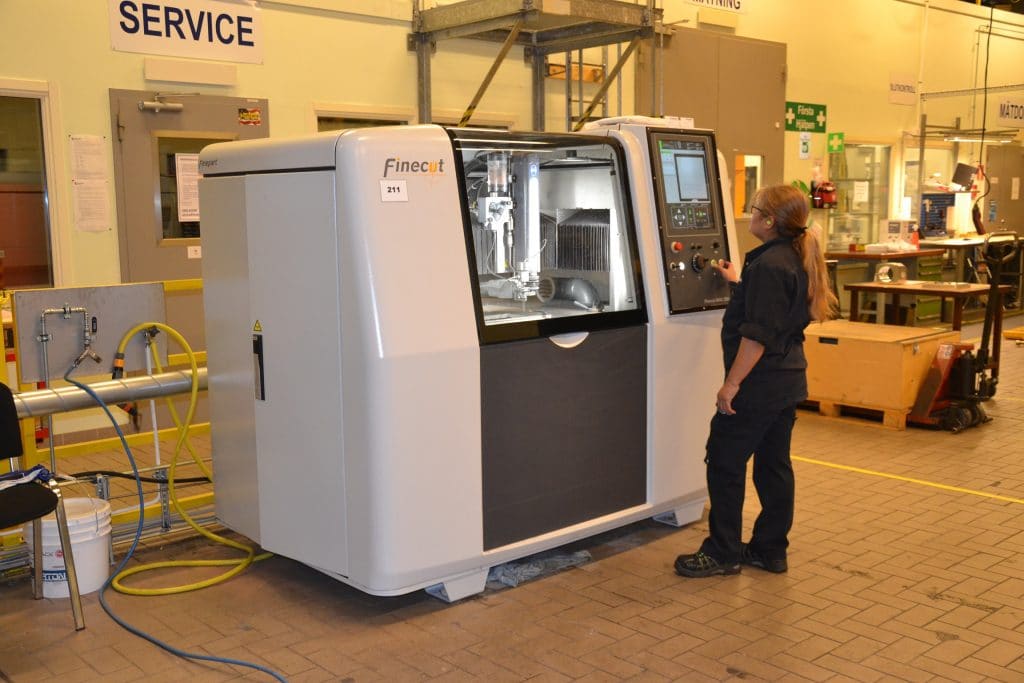
Brogren Industries required a cutting process that resulted in zero thermal impact on the Haynes 282 material. They initiated a collaboration with Finepart to evaluate micro-abrasive waterjet (micro-AWJ) cutting.
Unlike thermal methods, micro-AWJ is a cold-cutting process. It does not simply use “water that cools” a thermal cut; rather, it is a purely mechanical erosion process driven by high-velocity abrasives. Because there is no heat input, there is no HAZ, no metallurgical transformation, and no thermal distortion. Furthermore, the micro-AWJ process induces compressive residual stress into the cut surface, a characteristic known to actively improve the fatigue performance of metallic components.
The Finepart system also delivered the extreme precision Brogren required: ±2.5 µm system positioning accuracy, ±2 µm repeatability, and ±10 µm finished part tolerance.
Machine Specification
Positioning accuracy:
Repeatability:
Part tolerance:
Material:
Thermal impact:
±2.5 µm
±2 µm
±10 µm
Haynes 282
None

The Outcome: Precision Without Compromise
Following a successful proof of concept, Finepart demonstrated that their micro-AWJ equipment could easily process Haynes 282 without altering its material properties. Brogren Industries integrated the Finepart machine into their operations, completely avoiding the risks associated with thermal cutting.
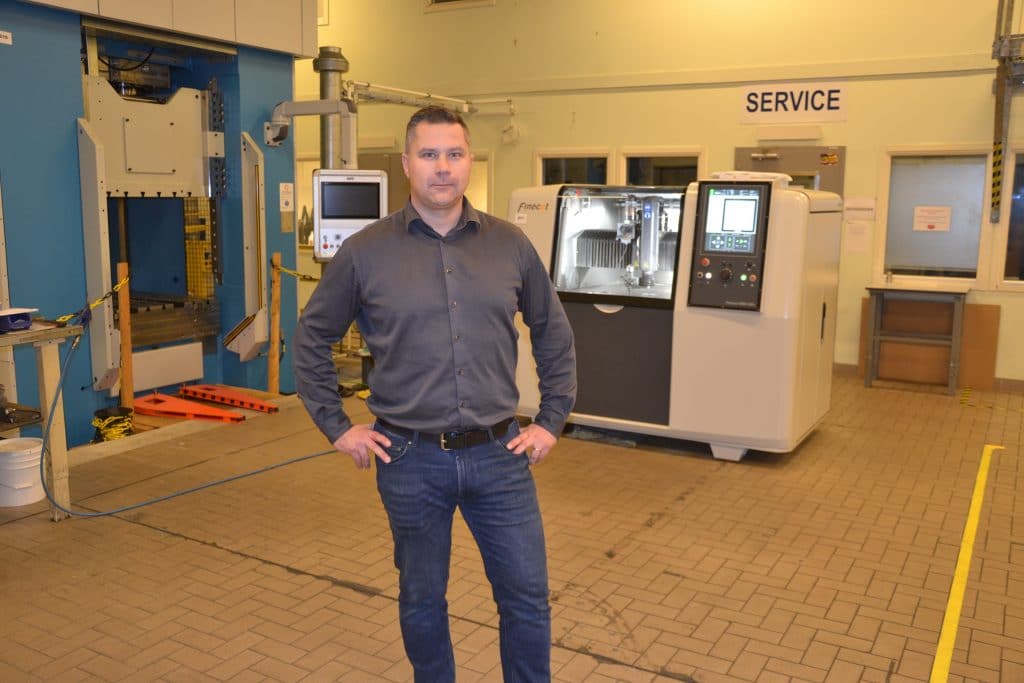
“We believe in long-term collaborations. Finepart met our requirements, and their micro abrasive waterjet process suited our needs well. They demonstrated the equipment to us, and we clearly saw the advantages of minimal impact on material properties and very high precision. Waterjet cutting on such a subtle level was completely new to us.”
Börje Andermård, CEO, Brogren Industries
While the COVID-19 pandemic temporarily shifted production volumes, Brogren used the available machine time to master the technology and apply it to other complex projects.
“The machine and equipment have worked very well. We have been able to use it in other projects and seized the opportunity to learn the machine better. I can genuinely recommend both micro abrasive waterjet cutting and Finepart.”
Börje Andermård, CEO, Brogren Industries
“Brogren Industries is an exciting Swedish tech company, and we are pleased that they see obvious benefits of micro waterjet cutting in general and our product in particular.”
Lars Darvall, CEO, Finepart
Technical Specifications & Advantages
Haynes 282 Properties
- Classification: Nickel-based superalloy (gamma-prime strengthened)
- Primary Applications: Aerospace and industrial gas turbines
- Key Traits: Excellent high-temperature creep strength, thermal stability, and superior weldability compared to older generation alloys.
- Machining Challenges: High strength, severe work-hardening, and susceptibility to thermal degradation (HAZ) under conventional cutting.
Finepart Micro-AWJ Benefits
- Zero HAZ: Purely mechanical erosion eliminates thermal damage and microstructural changes.
- Improved Fatigue Life: The cutting process induces beneficial compressive residual stresses.
- Unmatched Precision: ±10 µm finished part tolerance capability, supporting highly complex aerospace geometries.
Conclusion
For aerospace Tier 1–3 suppliers, successfully machining superalloys like Haynes 282 requires moving beyond standard tolerances. It demands absolute process integrity. By adopting Finepart’s micro-abrasive waterjet technology, Brogren Industries proved that it is possible to achieve micrometer precision without compromising the structural integrity of the world’s toughest materials.
Are you working with superalloys or hard-to-machine materials?
Don’t let thermal damage limit your production capabilities. Send us a drawing and we will prove it can be done.
References
- Kim, Y.-S. (2018). Comparison of Creep Properties of Cast and Wrought Haynes 282 Superalloy. Advances in Materials Science and Engineering. DOI: 10.1155/2018/2048959.
- Marimuthu, U., et al. (2016). Machinability of Nickel Based Superalloy by Abrasive Water Jet Machining. Materials and Manufacturing Processes, 31(13). DOI: 10.1080/10426914.2015.1103859.