
Academy · CNC machining explained
CNC machining, explained: how subtractive cutting shapes precision parts
CNC machining built modern precision manufacturing, and for an enormous range of parts it’s still the right tool. Understanding exactly how it works — and, just as usefully, where it runs into constraints — is what makes you better at choosing a process, not worse at using the mill.
The mechanism
How CNC machining works
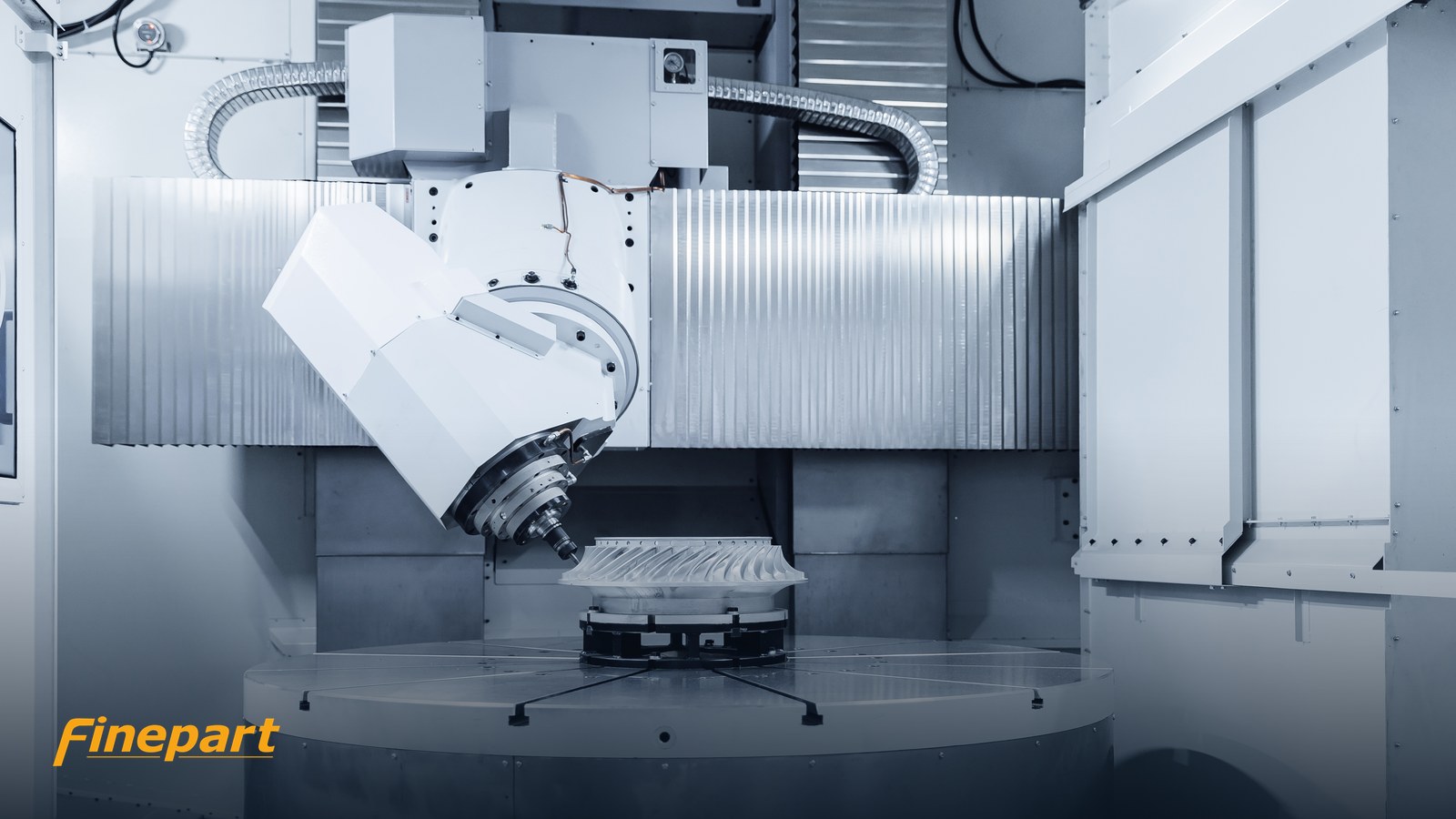
CNC (Computer Numerical Control) machining is subtractive: it starts with a solid blank and removes material to reveal the part, as opposed to additive manufacturing (3D printing), which builds it up. The removal is done by physical contact between a tool and the workpiece:
Milling
Rotating cutter
A rotating multi-tooth cutter removes material as the part (or tool) moves along multiple axes.
Turning
Rotating part
The part rotates against a stationary tool to produce cylindrical features.
Grinding
Abrasive wheel
An abrasive wheel takes fine, accurate cuts, often for hard materials and tight finishes.
Machines range from 3-axis (X, Y, Z) up to 5-axis, where the tool can approach the part from almost any angle to reach complex 3D geometry in one set-up. Getting from drawing to part means a chain of preparation: selecting tooling, designing fixturing (work-holding), writing and proving the CAM program, and cutting a first article. That set-up is where much of CNC’s cost and lead time lives.
The strengths
What CNC machining does brilliantly
For true 3D geometry — sculpted surfaces, threads, blind pockets, undercuts, tight-tolerance features and fine surface finishes — CNC is hard to beat, and on routine machinable materials (aluminium, steel, brass and the like) it’s fast and economical, especially at volume. If your part is a machined 3D component in a workable metal, CNC is usually the answer, full stop.
The limits
Where CNC machining runs into constraints
The same things that make CNC powerful — a tool in contact, guided precisely — define its limits:
01 — Economics
Tooling and lead time
Custom fixtures, tool selection and programming add real cost and days-to-weeks of lead time, felt most acutely on prototypes and low volumes, where there’s no production run to amortise them across.
02 — Force
Contact force on thin parts
Clamping and cutting forces distort thin, springy or delicate components and can leave residual stress that warps the part or reduces fatigue life later.
03 — Materials
Hard and brittle materials
Engineering ceramics, sapphire and hardened alloys drive rapid tool wear and risk chipping and sub-surface cracking — sometimes making tooling the dominant cost, sometimes making the cut impractical altogether.
04 — Geometry
Fine and deep internal features
Small internal radii, deep narrow slots and intricate internal contours are slow or impractical to reach with a rotating tool.
The alternative
When a non-contact alternative helps
When the binding constraint is tooling lead time, contact-induced stress, or a hard/brittle material, a no-contact, non-thermal process complements the mill rather than replacing it: it can profile difficult-material blanks and complex 2D/bevelled shapes with no wear and no stress, leaving the 3D detail to CNC. That trade-off — and where each process wins — is the subject of our waterjet vs CNC machining comparison.
See it on your own part
Tooling up for a part you’ll only make ten of?
Send us the drawing and material, and we’ll profile it with no fixtures, no tooling and no stress — straight from CAD.
No theoretical projections. Just data on your part.
FAQ
Frequently asked questions
What does “subtractive” mean in CNC machining?
Material is removed from a solid blank to reveal the finished part, as opposed to additive manufacturing (3D printing), which adds material layer by layer.
What is the difference between 3-axis and 5-axis CNC?
A 3-axis machine moves the tool in X, Y and Z; a 5-axis machine adds two rotary axes so the tool can approach the part from almost any angle, reaching complex 3D geometry in fewer set-ups.
What are CNC machining’s main limitations?
Tooling and lead time, contact forces that stress thin parts, difficulty with very hard or brittle materials (wear and chipping), and trouble reaching some fine or deep internal features.
When should I use waterjet instead of CNC?
For complex 2D and bevelled profiles, hard or brittle materials, and thin or stress-sensitive parts — especially prototypes you don’t want to tool up for. CNC remains best for true 3D features and fine finishes.
