
Academy · Laser cutting explained
How laser cutters work — and where laser cutting reaches its limits
Laser cutting is one of the most capable and widely used cutting technologies in manufacturing. It’s fast, flexible and software-driven, and for the right job it’s hard to beat. But like every process it has an edge of the envelope — and knowing exactly how a laser works, and where it stops working well, is what tells you when to reach for something else.
The mechanism
How laser cutting works
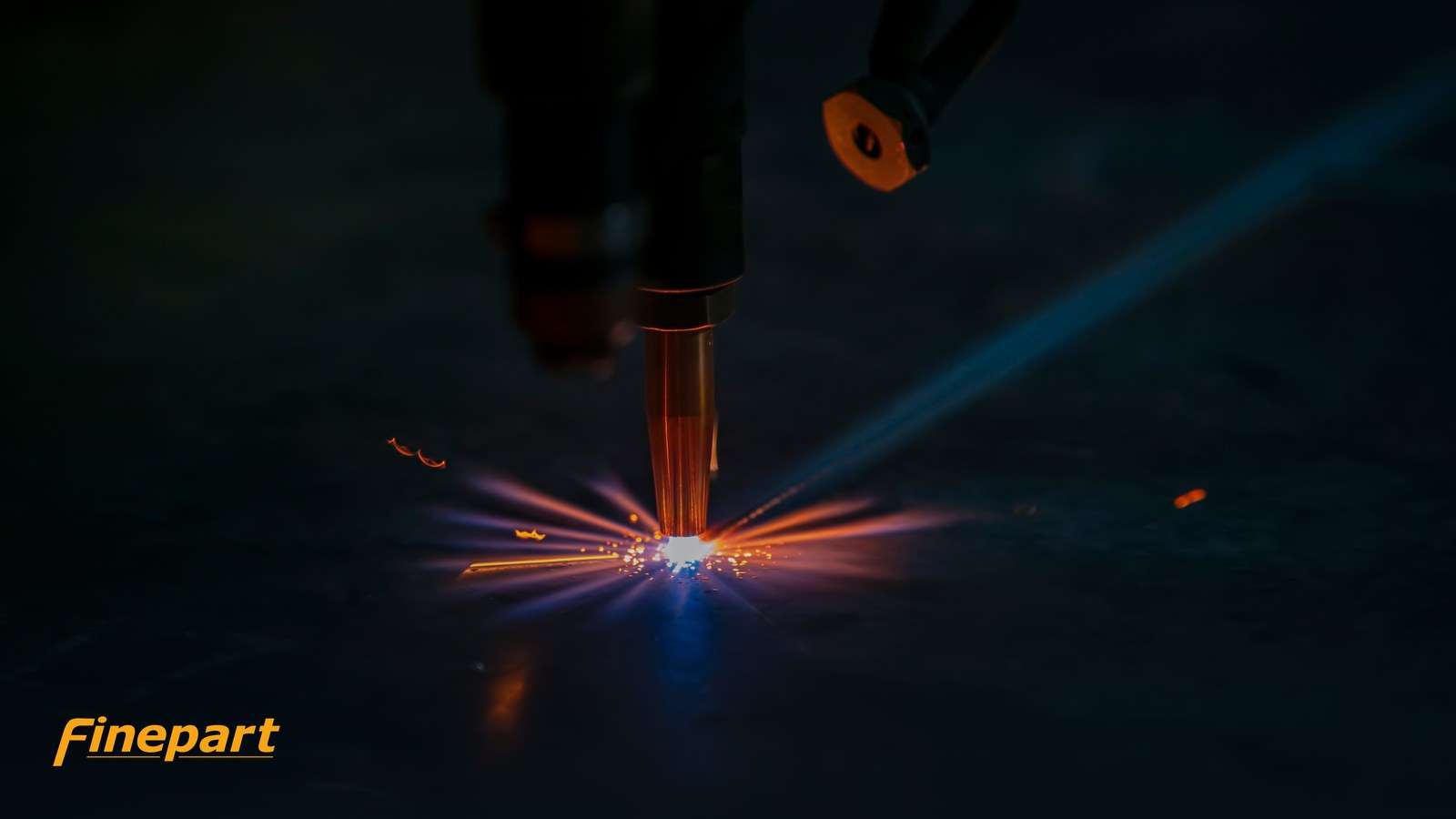
A laser cutter concentrates a high-energy beam onto a spot a fraction of a millimetre across. Two source types dominate industrial cutting:
Fibre laser — ~1 µm
Efficient, excellent on metals
The beam is generated in a doped optical fibre and delivered through fibre optics. Highly efficient, and the workhorse for cutting metals.
CO₂ laser — ~10 µm
Strong on non-metals
A longer-wavelength beam, historically strong on non-metals and thicker stock.
In both cases the focused beam heats the material until it melts or vaporises, and a coaxial assist gas (oxygen, nitrogen or air) blows the molten material out of the cut. The head pierces a start hole, then CNC motion drives it along the programmed contour. That thermal mechanism is the source of both the laser’s speed and its limitations.
The strengths
What laser cutting does well
For thin, flat sheet in common metals, laser is quick, accurate and economical, especially at volume. It nests many parts onto a sheet with minimal waste, cuts intricate 2D profiles, and switches between jobs in software with no tooling. It also marks and engraves. If your parts are essentially flat, not especially thick, and not sensitive to heat, laser is frequently the most productive choice available.
The limits
Where laser cutting reaches its limits
The same heat that makes laser fast is what constrains it.
01 — Material integrity
The heat-affected zone
Because it melts and vaporises, a laser leaves a heat-affected zone (HAZ): a band of altered microstructure beside the cut, sometimes with micro-cracks and, on some alloys, a recast layer that can run tens of microns deep and contain crack initiation sites. In titanium and nickel superalloys this can mean grain growth, dissolved strengthening phases and residual stress — changes invisible to a caliper but consequential for fatigue and certification. We unpack this in heat-affected zones in aerospace manufacturing.
02 — Reflectivity
Reflective metals
Copper, brass and gold reflect much of the beam and conduct heat away quickly, making them slow, unstable or risky to cut with many lasers — back-reflection can even threaten the source.
03 — Thickness & heat
Thick and heat-sensitive stock
Speed and edge quality fall off as thickness rises, and heat-sensitive alloys distort.
04 — Brittleness
Hard and brittle materials
Ceramics and sapphire are prone to thermal-shock cracking under a focused thermal load.
A special case
A note on ultrafast lasers
Femtosecond and picosecond “micro” lasers remove material by ultra-short-pulse ablation, achieving near-non-thermal, extremely precise cuts. They’re genuinely impressive — but they’re limited in material thickness and cutting power (so slower), and carry a high capital cost, which narrows where they make economic sense.
The alternative
When to consider a non-thermal alternative
When a part is heat-sensitive, reflective, thick, brittle or fatigue-critical — or simply cannot tolerate a heat-affected edge or a secondary finishing step — a non-thermal process earns its place.
That’s the comparison we make in detail in waterjet vs laser cutting: where the laser’s speed wins, and where cutting cold, with no heat-affected zone, wins instead.
See it on your own part
Is your part past the laser’s limits?
Finepart has built micro abrasive waterjet machines for non-thermal precision cutting since 2006. Send us the drawing and material, and we will show you the edge — on your actual production part.
No theoretical projections. Just data on your part.
FAQ
Frequently asked questions
What is the main limitation of laser cutting?
It cuts with heat, which leaves a heat-affected zone that can compromise material integrity on demanding parts — and it struggles with reflective, thick, heat-sensitive and brittle materials.
What’s the difference between fibre and CO₂ lasers?
Fibre lasers (~1 µm) are highly efficient and excel on metals, including thinner reflective ones; CO₂ lasers (~10 µm) have traditionally been strong on non-metals and thicker material. Both are thermal processes.
Can lasers cut any metal?
Most common metals, yes — but reflective metals such as copper and brass are difficult, and heat-sensitive alloys can be degraded by the thermal input.
Are ultrafast lasers non-thermal?
Nearly — ultra-short pulses minimise heat — but they’re limited in thickness and cutting power (so slower) and expensive, which restricts where they’re practical.
