
Process explainer · Micro waterjet
Micro abrasive waterjet cutting, explained: how it hits ±0.01 mm tolerances
Industrial components keep getting smaller, more complex and more sensitive to the way they are made. A stent, an optical aperture, a titanium implant, a sapphire watch part or an aerospace honeycomb panel can be ruined by the very heat or mechanical force used to shape it — and laser, EDM and conventional machining each add one or the other.
The basics
What is micro abrasive waterjet cutting?
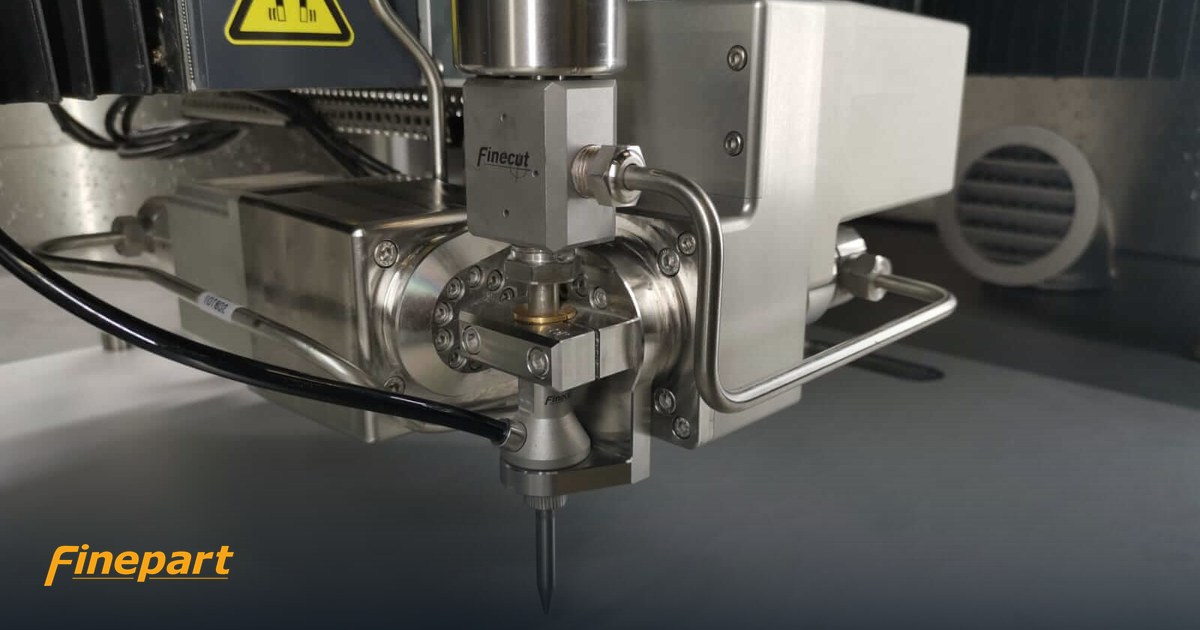
Micro abrasive waterjet cutting uses an ultra-high-pressure stream of water — usually carrying a fine abrasive — to erode material along a programmed path. Unlike the large “macro” waterjets that cut thick steel plate in fabrication shops, a micro abrasive waterjet is engineered for small parts and tight tolerances, with a jet that can be narrowed to a fraction of a millimetre.
It is not a faster version of the big macro waterjets — it is a different category. It preserves the material completely (no heat-affected zone, no recast layer, no tool stress), and it cuts virtually any material on one platform. For precision and safety-critical parts that means integrity you can certify; for R&D and advanced-materials work it means the freedom to make things that were previously un-manufacturable.
Variant 1
Pure waterjet
Water alone as the tool. Suits soft materials such as foam, rubber and gaskets, as well as some hard fibre materials like glass fibre and carbon fibre.
Variant 2
Abrasive waterjet
Hard particles are added to the stream, which lets it cut metals, ceramics, composites and glass. Micro waterjet cutting is almost always abrasive waterjet, refined for accuracy rather than raw throughput.
For a fuller primer on the process, see our guide to micro abrasive waterjet machining.
Material is removed by controlled particle erosion. Nothing melts, burns or recasts. That single fact is what makes the process so valuable, and it runs through everything below.
How it works
From 4,000 bar to micron accuracy
At a high level, the process is simple to describe and demanding to engineer.
STEP 1
Pressure generation
A high-pressure pump raises water to roughly 4,000 bar (around 60,000 psi).
STEP 2
Jet formation
The water is forced through a small orifice, accelerating it to several times the speed of sound.
STEP 3
Abrasive entrainment
Fine garnet or alumina is drawn into the stream in a mixing chamber, turning a water jet into a cutting tool — a jet as small as about 0.2 mm.
STEP 4
Material removal
The abrasive-laden jet erodes the workpiece particle by particle, piercing its own start hole and following the programmed contour.
STEP 5
Motion control
Linear motors, thermally stable Invar scales and a vibration-damped machine base position the jet to within microns.
The cutting head is only part of the story. The accuracy of a micro abrasive waterjet comes from the motion system and machine design as much as the jet — which is why purpose-built micro waterjet machines achieve results a scaled-down industrial waterjet cannot. Step 5 is where micron accuracy is won or lost.
The numbers
What “precision” actually means here
“Precision” is an overused word, so it is worth putting numbers on it. On a purpose-built micro abrasive waterjet system such as Finepart’s Finecut machines:
Positioning accuracy
On current 3-axis Finecut systems — with part tolerances to roughly ±0.01 mm (±0.0004 in).
Positioning
±1.5 µm
On current 3-axis Finecut systems.
Jet diameter
~0.2 mm
Enabling internal radii near 0.1 mm.
Because the jet pierces its own starting hole and cuts fine contours, a single setup can produce intricate features that would otherwise require multiple processes. For small, detailed parts, the combination of micron positioning and a near-burr-free edge is the practical difference between “close enough” and “to print.”
Why cold cutting wins
Why non-thermal cutting matters
Most cutting methods fight a trade-off between speed and damage. Thermal processes such as laser and plasma melt or vaporise material, leaving a heat-affected zone (HAZ): a band of altered microstructure, possible microcracks and, on some alloys, a recast layer.
On a fatigue- or safety-critical aerospace or medical part, that HAZ can reduce fatigue life or change material properties in ways that are invisible until the component is in service. We explain why heat-affected zones are a hidden risk in aerospace manufacturing in a dedicated article.
Micro abrasive waterjet is a cold process, so the material keeps the properties it had before cutting. For nitinol stents, titanium implants, turbine alloys and carbon-fibre structures, preserving material integrity is not a nice-to-have — it is the requirement. This is the core reason engineers move demanding work from laser to waterjet; see our detailed waterjet vs laser comparison.
Materials
What can micro abrasive waterjet cut?
Because it removes material by erosion rather than heat, waterjet is largely indifferent to a material’s melting point, reflectivity or hardness.
Metals
Alloys & superalloys
Stainless steel, aluminium, titanium, magnesium, copper and high-nickel aerospace superalloys.
Composites
No delamination
Carbon fibre and reinforced laminates, without delamination or melting.
Brittle
Crack-free edges
Engineering ceramics, glass and optical materials, with controlled, crack-free edges.
Soft
Polymers & elastomers
Many plastics, rubbers and elastomers.
The same machine can move from a hardened alloy to a brittle ceramic to a soft polymer with a change of program rather than a change of tooling — a flexibility that mechanical and thermal methods struggle to match.
Materials cut on the Finecut micro abrasive waterjet
Applications
Where micro waterjet cutting excels
Wherever parts are small, materials are demanding, or thermal and mechanical damage cannot be tolerated.
Medical
Stents & implants
Nitinol, titanium and polymer components where burr-free edges and no heat damage are essential. See why cold cutting matters in medical devices.
Aerospace
Superalloys & composites
Honeycomb and thin sections that must not distort or delaminate — as in our Brogren Industries case cutting Haynes 282.
Fine mechanics
Electronics & mechatronics
Small, intricate parts with tight tolerances and unchanged material properties — retaining spring properties is often a key requirement.
Optics
Brittle materials
Glass and ceramics that chip or crack under mechanical tools; see cutting brittle optical materials.
These are exactly the high-value, low-volume, material-sensitive niches where a few microns and a clean edge translate directly into yield, performance and certification.
Comparisons
Micro waterjet vs laser, CNC and EDM
Versus laser
Speed, but heat
Laser cutting is fast and excellent for many flat-sheet jobs, but it adds heat. On reflective metals, heat-sensitive alloys and fatigue-critical parts, the HAZ becomes a liability. Read the full waterjet vs laser comparison.
Versus micro-laser
Precise, but limited
Ultrafast-pulse micro lasers can also produce more or less non-thermal cuts, but are generally limited in material thickness and cutting power, which significantly reduces cutting speed.
Versus CNC & EDM
No tooling, no stress
Milling is unmatched for certain 3D features, but relies on tool contact, custom tooling and clamping forces that drive tool wear, stress thin parts and add lead time. Waterjet cuts complex 2D and beveled profiles with no hard tooling and no mechanical stress. Related: micro waterjet vs EDM.
Honest limitations
No process is universal
Where micro waterjet is not the answer
Micro waterjet is not the fastest way to cut very thick stock at volume — that is the domain of large macro waterjets and other bulk processes. It consumes abrasive, which is an ongoing operating cost. And for high-rate mass production of simple shapes, other methods may be more economical.
The sweet spot for micro abrasive waterjet is small, complex, high-value or material-sensitive parts where edge quality and material integrity are worth more than raw cutting speed.
Start with proof, not projections
When micro waterjet is the right choice
If your parts are small, intricate, made from heat-sensitive or hard-to-machine materials, or simply cannot tolerate a heat-affected zone, micro abrasive waterjet cutting deserves a place on your shortlist. It combines micron-level accuracy, a clean burr-free edge and the ability to cut virtually any material — without changing the material you started with.
Finepart has built micro abrasive waterjet machines for precisely this work since 2006. We will tell you honestly whether waterjet is right for your component.
FAQ
Frequently asked questions
What tolerance can micro waterjet cutting achieve?
Purpose-built micro abrasive waterjet machines reach positioning accuracy around ±1.5 µm and part tolerances near ±0.01 mm, with a jet as fine as roughly 0.2 mm.
What is micro abrasive waterjet cutting?
It is a form of abrasive waterjet in which a fine, high-pressure jet carrying abrasive particles erodes small, detailed parts to micron tolerances — without heat.
Does waterjet cutting cause heat damage?
No. Waterjet is a cold, non-thermal process. There is no heat-affected zone, recast layer or thermal distortion, so material properties are preserved.
What materials can micro abrasive waterjet cut?
Virtually all materials — including titanium, stainless steel, aluminium, superalloys, carbon-fibre composites, ceramics, glass, plastics and rubber.
Is waterjet better than laser for small precision parts?
For heat-sensitive, reflective or fatigue-critical materials, often yes, because it adds no heat. For high-speed cutting of flat sheet, laser may be more productive. Ultrafast-pulse micro lasers can achieve extremely high precision, but waterjet often has the advantage in cutting speed and investment cost.
